About Potsdam
Potsdam is known for its Prussian palaces, lakes and gardens that have been built in the past 300 years and embody a harmonious balance between the architecture and landscape. Special mention goes to the palace of Sanssouci and the Orangerie Palace.
The city is over 1000 years old and was house to Prussian Kings and the German Kaiser until 1918. It sits on the River Havel and lies on the hilly morainic landscapes.
Potsdam has approximately 180,000 inhabitants and borders Berlin.
The city was proclaimed one of UNESCO’s World Heritage Sites of parks and palaces along the idyllic lakes of the Havel River.
Why was it chosen as a ‘Pilot City
The Potsdam case in DivAirCity is unique because it doesn’t involve the Local Authority but a private housing association. They have committed to the partnership with DivAirCity to test new approaches and measures in the pilot area and eventually scale to other areas in their property. The housing association puts its own funding into DivAirCity for delivering the work needed from their side and self-funds their employees. The costs of the physical interventions will be partially covered by the DivAirCity budget, as explained in the cost section. The rest of the investment is private.
The main objectives of the city of Potsdam are:
Low threshold access for all different participants and citizens
Better air quality
More biodiversity
More accessibility to public green space
The Potsdam Living Lab focuses on building a bottom-up network through ‘urban green hotspots’ (digital-analogue spaces). These connect knowledge from data and technology with local people in the neighbourhood. With the help of digital tools and low-threshold nature-based solutions, the local community is given an understanding of the links between air quality and other urban factors and their health.
Area of Intervention
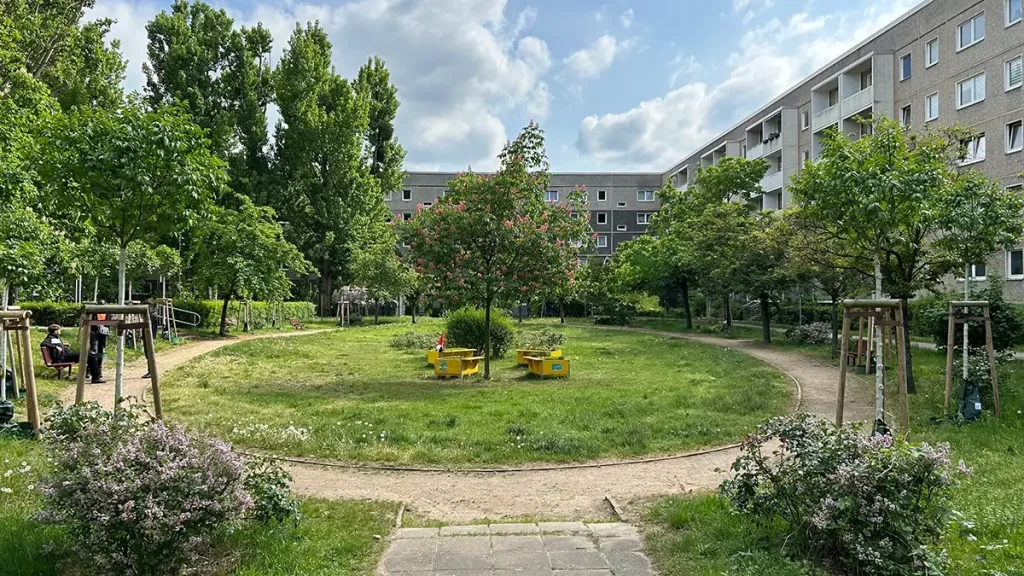
The intervention area for the Potsdam Permanent Living Lab is the Binsenhof, a courtyard near the busy street ‘An der Alten Zauche’. The courtyard is surrounded by blocks of flats belonging to ProPotsdam, an urban business association of the state capital. Many people with a migration background, mobility and other restrictions as well as older people live here.
Potsdam is characterised by increasingly high temperatures and high humidity, and there is a lack of shady and cool places that citizens can use to relax or exercise.
Activities in the City/Introducing the Potsdam Pilot Project
The goal is to establish a bottom-up network as a collaborative effort of private, non-profit, social, ecological, and technical local and individual actors to co-create and engage the local community in the intervention process.
Urban Green Hotspot:
The intervention aims to revitalize an underutilized, polluted, and heat-stressed courtyard, transforming it into a vibrant “Urban Green Hotspot” overlaying a green, communal and digital layer. Through low-threshold Nature Based Solutions, the goal is to create a green space that enhances urban life quality for a diverse neighbourhood. The “hotspot” offers a small ecosystem with high biotope values and the capacity to sequester carbon emissions by boosting green volume and biodiversity and an interaction through QR-Code-Storytelling.
Friendly Air Walk:
Through an immersive QR-Code walk enriched with storytelling, the intervention will share insights, data, and solutions to urban challenges. Scattered throughout the neighborhood, participants can learn about urban wellbeing and air quality while earning rewards by adopting “Air-friendly” behaviors. The interactive adventure with the Friendly Air Walk utilizes a gamification approach for an engaging digital analog experience – bridging the gap between nature, technology, knowledge, and people.


